
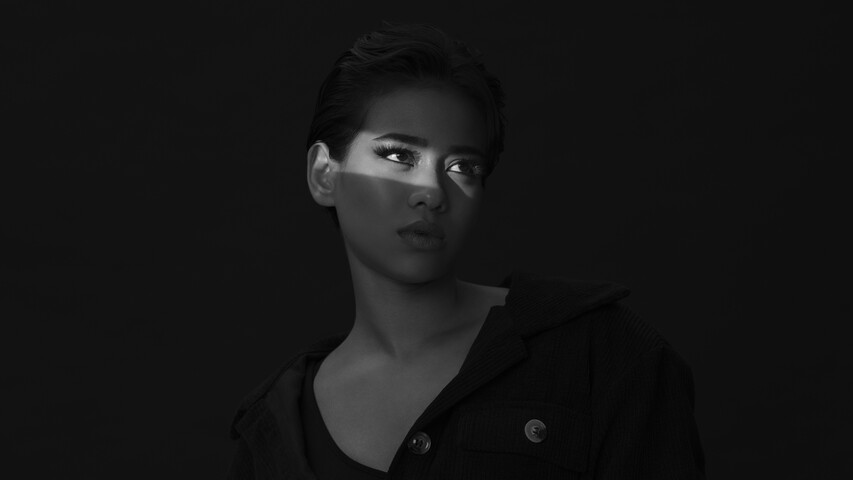
Singapore's Muttiah Ashnim has spent much of the past decade shaping underground techno scenes across Southeast Asia. Through her former collective Into The Deep, she helped nurture dancefloors and communities in Singapore, Malaysia, Indonesia, Thailand, Cambodia, and Myanmar — including securing a residency at Myanmar’s first techno club through the collective’s Uncaged event series. In 2024, she made the decisive move to close Into The Deep, not as an ending, but as a turning point.
Now based in Germany, Muttiah Ashnim has re-emerged as a full-time DJ and producer, fully committed to developing her own sound. In 2025 alone, she released 11 original tracks, including her latest EP Pain on Vision Serpent, that reflects her growing confidence as a producer. Her recent guest mix on Proton Radio further captures this evolution — immersive, focused, and rooted in dark techno that prioritises atmosphere and connection.
Beyond the music, Muttiah’s journey is shaped by persistence: breaking generational expectations, navigating a male-dominated genre, and redefining success on her own terms. As one of the few female Singaporean producers carving out an international path in dark electronic music, her story speaks to both resilience and reinvention.
You recently released a fantastic EP called Pain on Vision Serpent. Could you tell us a bit about what you were exploring creatively with this release?
‘Pain’ and ‘Mind’ were among the first tracks I ever produced. At that point, I was honestly just exploring Ableton and learning through experimentation. With every track that I’ve produced, it starts with experimenting until something starts to evoke emotion. That’s usually when I know that something with potential is in the works.
With ‘Pain’, after many tries, the synth melody suddenly clicked and sounded strong. My husband even commented that it sounded like something out of Mortal Kombat. ‘Mind’ leans more into a minimal style, something I’m still very drawn to. It focuses heavily on percussion, allowing the groove and subtle movement to lead the track.
Both remixes on the EP were really interesting. What made TiM TASTE and Verschallt the right artists to reinterpret ‘Pain’ and ‘Mind’?
TiM TASTE is one of my favourite artists. Every track he releases feels different, yet he always maintains his unique style, which I really admire. He taps into a deep sense of darkness that I find fascinating, so having his interpretation of ‘Pain’ felt like a natural choice.
Verschallt has also quickly established his own path in the scene. His rolling basslines and the journeys within his tracks really stand out to me, so he was another obvious choice. Both artists interpreted the tracks in their most authentic way for the EP.
When another artist remixes your track, how much freedom do you like to give them, and what excites you most about hearing your work reinterpreted?
I take zero credit for remixes. It’s not my style to tell someone how they should make music. Artists have complete freedom with their remixes. Every remix is an honour because the artists essentially start from scratch using the sounds I share — like synths, percussion, vocals, and atmospheres. What excites me most is hearing how they reshape the material into something entirely their own.
You had a massive show at Amsterdam Dance Event this year. What was the experience like for you?
It was a defining moment for me. I genuinely didn’t expect it to happen this year [in 2025], so it came as a really good surprise. I met many passionate artists, experienced Amsterdam for the first time, and felt very inspired by the energy there. I’m incredibly grateful to my B2B partner TiM TASTE and to Divergent Label for making it possible.
What has been the biggest adjustment in establishing yourself in Germany?
Starting from scratch has definitely been the biggest challenge. In Southeast Asia, people knew my background, my music, and my work, so life felt very busy and familiar. Restarting in Germany forced me to slow down and refocus, which turned out to be a positive shift.
It reinforced my skills as a DJ — people started discovering me purely for my sound rather than already knowing my story. Production-wise, I’ve always had sounds in my head and wanted to put them into some sort of form, but I was afraid to start. This reset gave me the opportunity to fully commit to that side of my practice. At the core, nothing has really changed. I now have more time to focus on music, which is a massive win for me.
Having to shift to new environments and crowds, has there been a recent gig that challenged or shifted you creatively as a DJ?
Actually, I feel every gig and every crowd is unique in its own way, so the level of work and attention required always feels the same to me. That’s what I love about DJing; it’s never just about playing tracks. It’s about reading the crowd, engaging them, evoking curiosity, and taking everyone on a journey together. Every dancefloor is different, regardless of geography.

Prior to moving, you played a key role in developing underground techno scenes across Southeast Asia. What were some key lessons from those early years as a promoter that have shaped you as an artist today?
One of the most important lessons I learned early on was never to let anyone dictate my creative direction. Back in the mid-2010s in Southeast Asia, many people thought the music I played and wanted to promote was too dark, too deep, or too “techy”, but I did it anyway. We have to start somewhere, but start strong.
I also learned to understand all the different elements beyond music that shape the experience for ravers — like how to create an atmosphere where people feel comfortable enough to leave their differences behind and become one on the dancefloor. That sense of connection is important to me, and whether as a promoter or as an artist, how I can elevate that experience fully is something that really matters to me.
As a woman from Singapore building a career in dark techno, what have been some defining moments that have guided your confidence and direction?
One of the biggest defining moments was when Uncaged, one of the event series of Into The Deep, held a residency at Myanmar’s first techno club, Level 2. After COVID, I was booked by local promoters and met DJs who told me it was Into The Deep that first introduced them to techno. That really hit me. It meant a lot.
Many moments that build my confidence come from conversations after a set, when people tell me how they felt and the journey they experienced. I feel honoured and humbled every time that happens.
Producing music has been another major turning point, especially in a genre where there are still very few female producers. It moved me from being perceived primarily as a DJ to being recognised as a producer with my own sounds — sounds that I’m still discovering.
Another important moment was shutting down Into The Deep. It was a difficult decision, but organising events consumed a lot of time. It had served its purpose, and I’m now able to fully focus on my passions, which are DJing and production.

Were there moments where cultural or generational expectations conflicted with your decision to pursue this path?
I don’t think I ever doubted my career in music, but coming from a conservative background where women are often expected not to be seen or heard, this path wasn’t widely understood or supported. It was never going to be easy. These challenges only pushed me to define success on my own terms and to pursue my vision.
Finally, what are your personal and professional goals for 2026?
Personally, I’d love to speak better German and probably get back into Muay Thai. Professionally, I hope to play at my first festival — and then some — or at least have my music played at festivals. Production-wise, I’ll continue focusing on discovering sounds and having fun making tracks.


