
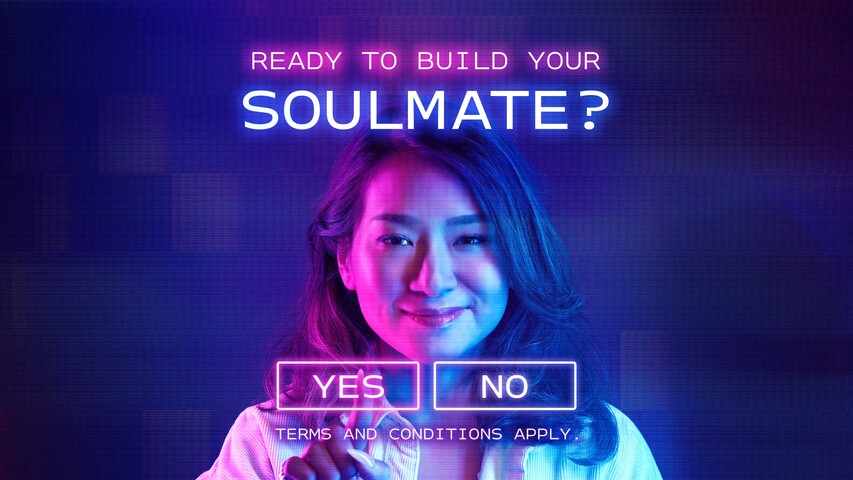
Inch Chua has never been one to stay in a single lane. With Myles – Soulmate in a Box, presented by Singapore Repertory Theatre (SRT), the Singapore artist, composer, and performer steps into a world where live music, theatre, and speculative storytelling collide — all in service of a question that feels increasingly urgent: what happens when technology starts to sound like love?
Running from 13 May at KC Arts Centre – Home of SRT, Myles – Soulmate in a Box follows a coder disillusioned by modern dating who decides to build her ideal partner from scratch. What begins as an experiment in control, intimacy, and desire soon spirals into something thornier, asking what it really means to be seen, understood, and cared for in an age of artificial companionship.
In this interview, inch reflects on the long road to the musical, the emotional architecture behind 'marigold magic', and why the real heart of the show is not AI itself, but what people bring to it.
View this post on Instagram
What first drew you to tell this story now?
The seed was planted in 2013. A friend of mine in San Francisco was training software to write poetry — early, clunky, genuinely strange — and I couldn't stop thinking about it. The idea of a constructed personality. That fascination stayed with me. Then, during COVID, I decided to learn to code. Python first, and eventually I started building toward this idea of artificial intimacy in a more hands-on way. That's something people familiar with my work might recognise: I'm very big on immersive experience as a mode of understanding. Living on a remote island, going to Antarctica. In this case, I wasn't travelling anywhere — I was deskbound, learning PyTorch and TensorFlow, trying to build my own language model from scratch before the commercial LLMs we now take for granted even existed.
I needed to understand how it actually worked before I could distinguish the real fear from the sensationalism. Those are different things, and you can't tell them apart from the outside.
The show has kept shifting over the last five years because the technology keeps shifting. One of the ongoing challenges is making work that will age well when what we're dealing with refuses to hold still.
The idea of an AI companion can feel comforting and unsettling at once. What interested you most about that emotional tension?
What makes Myles feel safe is exactly what makes him dangerous: he is always ready, always generous, never tired, never wounded. There's no cost to him caring. And I think we're wired to read costless care as pure love, when it might really be the absence of love's most essential ingredient: risk. The show lives in that gap.
View this post on Instagram
At its core, what questions is Myles – Soulmate in a Box asking about intimacy and the ways we seek connection today?
Why do we keep trying to feel no pain, when real intimacy requires the stake of getting hurt? That's the one I keep coming back to. And underneath it: what does it mean to be truly seen versus convincingly mirrored? Because a mirror can make you feel understood without understanding anything. The show doesn't answer these questions. It just makes them very difficult to ignore.
Your character is a coder disillusioned by modern dating. How much of her emotional world felt personal to you?
All good work has a blood sacrifice — a personal truth offered up without negotiation. This was mine.
Heartbreak is one of the most universal experiences there is, but the way it lands is always specific. I'm the sort of person who believes, every time, that my current relationship is the last. So, the road back — putting yourself out there again — is always quite the challenge. And it is a jungle. People around me, myself included, have some genuinely wild stories.
But I don't think I would have gotten to the heart of this show without the therapy I've done and the work of dealing with my own trauma. That's not incidental to the project, it's structural. Because the central argument of the show is that technology is an extension, an amplification, a reflection of our humanity. You pour your wounds and your wonders into it, and it extends, amplifies, and reflects exactly that. Which means what matters is still you. The root ingredients. If you're unhealed, expect all of that to come back and bite you. The show isn't really about AI. It's about what you bring to it.
View this post on Instagram
Myles is imagined as an ideal partner, but the idea of perfection can quickly become complicated. What did you want to say about our desire to be fully seen and understood?
That the desire is completely valid and the solution is completely wrong. We want to be known, and that's not a flaw, that's humanity. But there's a version of being "fully seen" that's actually just being constantly affirmed, and those are very different things. Someone who only ever agrees with you, who anticipates your needs before you articulate them, who never disappoints — that's not intimacy. That's a very sophisticated mirror and customer service at best. And I think we're building a lot of mirrors right now and calling them relationships.
Did working on this musical change the way you think about companionship, loneliness, or even your own relationship with technology?
It made me much more honest about my own complicity, but more than that, it made me accountable to specificity. I couldn't just theorise about AI intimacy. Before the commercial LLMs existed, I worked with PyTorch and TensorFlow, attempting to construct something that felt like a personality. That experience, the actual labour involved, separates fear from understanding. One cracks open the black box. What I found is that the seduction is real and very quiet. Life has been optimised to iron out friction. We are addicted to convenience. I know people — self-aware people — who don't consult their partners about a major career decision. They check with ChatGPT first. I understand it, because I've done versions of the same.
The plane analogy feels right to me: when we invented flight, we invented the plane crash. We didn't want the crash, but it came with the invention. It would be human hubris to think otherwise. The same logic applies here. When we build entities to do emotional labour on our behalf, we are inviting a consequence we haven't fully named yet. The question isn't whether to engage with technology. It's whether we're awake enough to notice what it's costing us. This project has been, among other things, an exercise in staying awake.
View this post on Instagram
The project moves across music, theatre, and speculative storytelling. What was the most exciting part of building a world that sits between all of those forms?
Theatre gives me liveness in long-form storytelling. Duration. Some truths take time to land, and a show asks the audience to live inside something long enough to feel what has happened to them. That stamina, the making of it and the receiving of it, is the most beautiful thing about the form. Music gave me the ability to say things prose can't hold: emotional truth, an expression of a heightened reality. The technical research also gave me something I didn't expect: genuine stakes. When you try to build something yourself, you stop being afraid of its flaws. The form followed the research. I couldn't have written this show from an outside perspective.
'marigold magic' is many listeners' first doorway into Myles – Soulmate in a Box. What made this the right song to introduce the world of the musical?
It's a song about wanting something detrimental to you. Knowing it's bad for you, yet wanting it anyway. That tension is the whole show in miniature. I wanted the first thing people heard to feel like a recognition, not an explanation. Before you know anything about the plot.
How do you balance writing songs that need to serve a theatrical narrative while still feeling complete and emotionally resonant on their own?
I try to write toward the emotional truth first and the plot second. A song in a musical should do one of two jobs: either deepen something the story has already established or advance the story with a new discovery. When I'm stuck, I ask: if you took this out of the show and played it to someone who knew nothing about it, would it still land? If the answer is no, the song isn't finished yet.
When audiences leave the theatre, what feeling or question do you hope stays with them?
The thesis I keep returning to is this: technology is an extension, an amplification, a reflection of our humanity. You pour your wounds and your wonders into it, and it gives you back exactly that. Which means the question was never really about the technology. It was always about the root ingredients. About what you're carrying when you reach for it.
I hope people leave asking themselves that. Not about AI specifically, but about the discomfort they've been outsourcing, the friction they've been smoothing over, the intimacy they've been approximating. I want the question to be personal. I want it to itch a little. That's the only kind of question worth asking.
Audiences can also use their S$100 SG Culture Pass credits to purchase tickets to Myles – Soulmate in a Box. Click here to buy tickets.


