
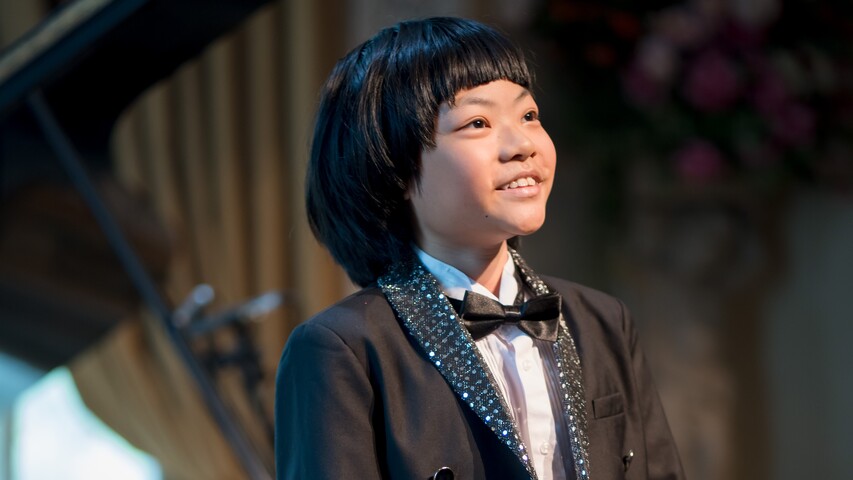
When Hear65 first spoke to Mikkel Myer Lee in 2024, the young Singaporean pianist was just beginning an extraordinary challenge: performing Beethoven’s complete 32 piano sonatas in a multi-year concert cycle. Two years on, that journey has taken him far beyond home stages, with performances in London, Amsterdam, and Thailand, as well as a television debut on the Dutch classical programme Podium Klassiek.
Now, Mikkel is set to return to Singapore for his upcoming homecoming concert at the Esplanade Concert Hall, where he will present Part Three of his Beethoven Sonata cycle. The programme features Sonata No. 2, No. 20, No. 26 'Les Adieux', and No. 23 'Appassionata'—a set he describes as full of contrast, character, and different sides of Beethoven.
We caught up with the remarkable prodigy to discuss how his relationship with music has deepened, what international audiences have taught him, and how travel, rest, and curiosity continue to shape his artistic growth.
View this post on Instagram
The last time we spoke, you were just beginning your Beethoven Sonata series. Looking back now, what feels most different about you as a musician today?
Honestly, I’m not sure there is one big change. I think I feel the music more deeply now, and I’m always thinking about how to play and express what I feel in it. It has become more intense for me. Sometimes something that only lasts a few seconds on stage can stay with me the whole day. When I practise, I keep trying to shape it the way I imagine, whether it is the intensity, the speed, or the feeling. I will keep experimenting the whole day, thinking about it even before I sleep. Sometimes, I can’t fall asleep because of it.
You’ve now brought parts of this journey to international stages. Did playing in London, Amsterdam, and Thailand teach you anything new about how audiences connect with classical music?
I feel that music is really a universal language. No matter where people are from, they can connect to music in their own way.
In Amsterdam, it was very memorable because many people stayed back after my concert to share how they felt and which moments they liked the most. Some of the audience in Amsterdam told me that they saw me in the Podium Klassiek segment, a classical TV show in Amsterdam where I made an appearance and performed for a few minutes just a week before my debut there, and they specially bought tickets to watch me. After the TV show in Amsterdam, I met quite a few people who came up to me telling me how much they loved my playing. I feel people there really love classical music and appreciate it a lot. I also think it is really great to have a regular classical music show on national TV.
In London, I could feel how quiet and focused everyone was, and it made me feel very connected to them while I was playing. In Thailand, I felt a very warm and welcoming energy. Even though we may not speak the same language, I felt that we understood each other through the music. In Singapore, I’m also very touched because some audience members have followed my journey since I was nine and have come for many of my concerts. That means a lot to me.
View this post on Instagram
You mentioned that you made your television debut on the Dutch programme Podium Klassiek. What was that experience like?
It was a very special experience. Playing on television feels quite different because you know many people are watching from different places. But at the same time, I just tried to focus on the music. It was also nice to be part of a programme that shares classical music with a wider audience.
Has there ever been a performance on this journey that changed your confidence in a major way?
Not really in a big or sudden way. I think my confidence comes from within. As long as I’m prepared, I feel confident. I just focus on giving my best each time, and I always feel good being on stage. I really enjoy performing, and I feel happy and grateful to be performing.
Has travel itself become part of your artistic growth? Are there places, audiences, or moments from your recent trips that have stayed with you?
Yes, I think travel is very important for me. It helps me recharge and reset, and it keeps me happy and calm. I am not sure exactly how, but when I feel happy and calm, I think it might help my playing in a more natural way.
For example, in Nepal, it felt very lively in the city and also very quiet and peaceful in the mountains. And in Machu Picchu, it felt very powerful and still at the same time. I am not sure how to explain this clearly, but maybe these kinds of experiences stay somewhere in me and come out in small ways when I play.
Back in 2024, you spoke about staying motivated by setting goals for yourself. What do your routines look like now, and how have they evolved?
I think my routine is similar, but more structured and busier now because I have more performances and goals happening at the same time. I still set big goals for the long term, and smaller daily goals to keep improving step by step. I also need to manage my time more efficiently now.
I can’t really practise as many pieces in a single day as before, so the way I practise has changed. I focus more carefully on what I need to work on each day. For example, when I am short of time, which I am most days, I focus more on specific areas that need improvement instead of going through many pieces in a day. That could be working on getting a clearer sound, shaping the expression the way I want, achieving a certain speed, or getting comfortable with a new fingering I’ve just changed.
As your performance calendar grows, how do you balance technical practice with rest, curiosity, and simply enjoying music?
I try to balance practice with rest by taking proper breaks after performances and also having time away from the piano. Sometimes that means short holidays where I don’t think too much about playing, and other times it’s just moments in the day where I step away and reset.
For example, last April I spent almost a month in Amsterdam. I would still practise about three to four hours a day, but I also had time to go out on the canals and drive a boat, or visit the tulip fields in the morning and then return to the piano in the afternoon.
There are also times when I ask my parents to bring me to a piano practice room even during holidays, because I don’t want to feel too out of touch. But there are also trips where I am completely away from the piano. For example, last October, when I was in Brazil and Peru, I spent about three weeks with no piano at all, just travelling, listening to music in the streets of Cusco, and doing a lot of photography and videography. I think both kinds of breaks are important for me.
View this post on Instagram
Your upcoming homecoming concert features Beethoven’s Sonata No. 2, No. 20, No. 26 'Les Adieux', and No. 23 'Appassionata'. What excites you most about Part Three?
I think it is the contrast between the sonatas. Each one has a very different character, and together they show different sides of Beethoven. I am especially looking forward to sharing this journey with the audience. I am also excited to be back at the Esplanade Concert Hall again, and to perform in front of a big audience once more!
'Appassionata' is often seen as one of Beethoven’s most demanding sonatas. What has the process of preparing it been like for you?
Preparing Piano Sonata No. 23 ('Appassionata') has been quite intense. It is not just technically demanding, but also emotionally very deep. I keep finding new challenges every day, and I’m often not fully satisfied with certain parts because I’m still trying to bring out the energy the way I hear it in my mind.
Sometimes I can spend a whole day on just a few bars because I don’t feel ready to move on until I can make it sound the way I want. It can be really intense for me, but it feels important to keep searching until it sounds right to me.
Finally, when audiences come to Part Three in Singapore, what do you hope they will leave the concert hall feeling or thinking about?
I hope they enjoy the music and have a meaningful experience. For those who are coming for the first time, I hope they will simply enjoy the music and feel that classical music is something they can connect with in their own way.
For those who have been to my previous concerts before, I hope they will continue to come for the rest of the journey, as each concert shows a different part of Beethoven’s world and also a different stage of my own growth.


