

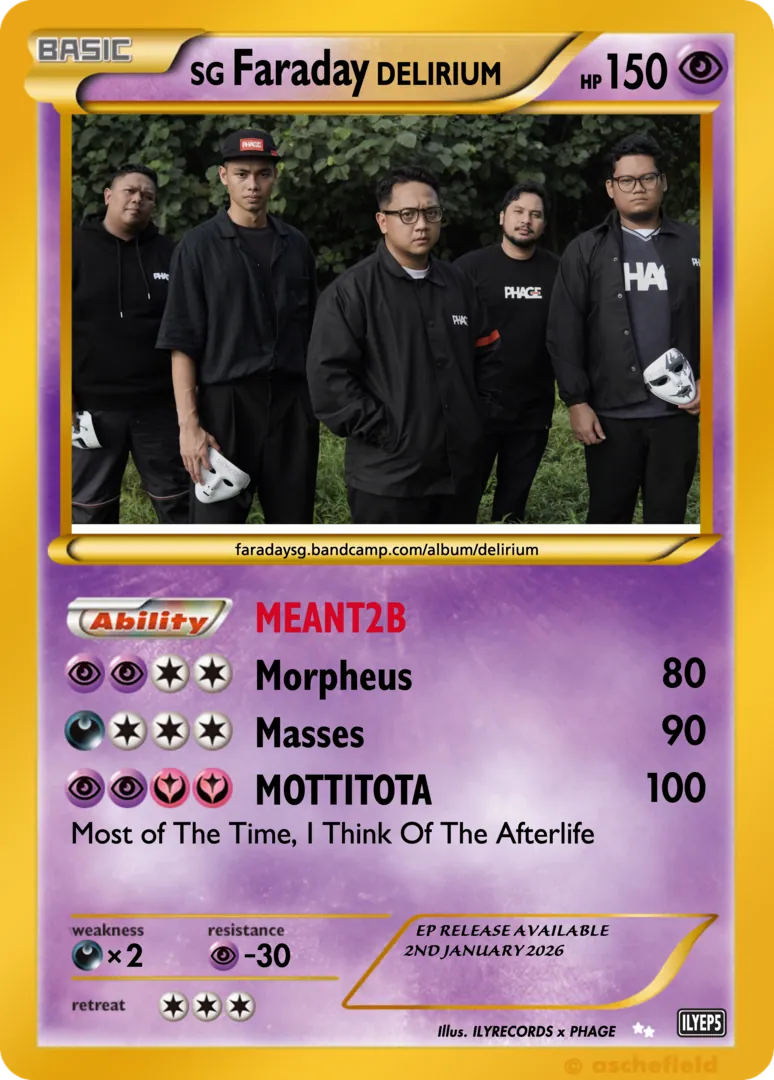
Singapore post-hardcore outfit Faraday have never shied away from emotional weight, but with DELIRIUM, they push their songwriting into something far more expansive and mythic. The EP marks the first chapter of a Sandman-inspired trilogy that will eventually culminate in a full-length album titled Endless, drawing from DC’s The Sandman universe while remaining deeply rooted in the band’s own lived experiences.
Centred on Delirium, the youngest of the Endless and the embodiment of chaos, fragility, and nonlinear thought, DELIRIUM explores emotional turbulence through crushing riffs, cinematic textures, and moments of unexpected vulnerability. Across four tracks — from the longing of ‘MEANT2B’ to the existential closer ‘Most Of The Time, I Think Of The Afterlife’ — Faraday blur the line between fantasy and reality, using mythology as a mirror to the modern world.
The band spoke to Hear65 about why Delirium was the right place to begin, how chaos shaped the record, and what lies ahead as the trilogy slowly unfolds.
DELIRIUM is the first chapter of a Sandman-inspired EP trilogy. Why did Delirium feel like the right character to open this larger narrative with?
We perceived Delirium as the strongest of the Endless. From Delight to Delirium, she’s the only one to ever change “roles”, and when that did happen, even Destiny — eldest of the Endless and the all-knowing — didn’t see that coming.
Out of all the Endless, Delirium also seems to be the most fun. That’s also a very important part of our songs, or at least that’s what we hope our listeners will feel when they listen to the EP. Fun within all the noise.
Delirium embodies chaos, fragility, and nonlinear thought. How closely did those ideas reflect where you were mentally or emotionally as a band while making DELIRIUM?
As much as we all put up a strong front, we were all personally affected within the depths of ourselves with all the chaos happening in the world then and now. As a band, we don’t like getting too political, but we do try to raise awareness via what we know best — music — which we touched on kind of subtly explicit in our single ‘Jester’.
It was from then where we realised the world has always been a mess. It’s just that we find our little piece of calm and peace in our own ways. And even then, you will still be surrounded by the chaos — struggles, trials, problems, and challenges in life.
We believe that all this negative energy has to be turned into something positive. We love facing our demons head-on. Faraday has been an avenue where every member has the right to pour out everything and anything they feel and birth songs with it — something that we love doing, writing noisy, emotional songs.
Just like the Endless, Delirium will always be part of a person, part of us. The uncertainty of what’s to come and what may happen is an exciting mystery that we look forward to experiencing and growing from.

The EP draws inspiration from The Sandman’s Brief Lives arc. How did you approach translating such a visually rich, literary story into something purely sonic?
Won’t lie, it wasn’t easy. (Laughs) We tried dabbling with synths and samples in hopes to achieve a “Sandman-ish” sound, but then realised that if we did that, we’d just be copying what’s already been done.
So we interpreted the whole thing ourselves and decided to use a more “digital”-sounding synth and samples in the EP, as heard in the intro of ‘Morpheus’, and a grand orchestral focus for ‘Most Of The Time, I Think Of The Afterlife’.
The majority of the EP focuses mainly on the sounds of heavy guitars, grungy bass, and hard-hitting drums, accompanied by coarse vocals and screams, which feels more authentic to the band.
‘MEANT2B’ opens the EP with a sense of longing and mythic romance. Why was this the right emotional entry point into DELIRIUM?
This is the song that we wrote in the shoes of Delirium. She was closest to her brother, Destruction, who abandoned his realm and went on the run to live as a mortal being. That made Delirium sad, longing for the love and attention of the one who never judges her and understands her.
It’s like having an elder sibling that dotes on you and always knows how to make you happy. It felt right to open with this as it doesn’t only focus on Delirium, it also focuses on Destruction. Fun fact: although this whole EP is named after Delirium, the four tracks actually describe Destruction’s character sonically.
When we say “destruction”, what comes to mind? Buildings being demolished, trees being burnt down, the breaking or destroying of something. But we forget that in order for something new to come, the old must be taken away. An old building being demolished to make way for new buildings that might house families, trees being burned down to make space for a theme park where people can laugh and have fun. Diamonds are made under pressure.
We depicted this whole concept by portraying destruction with the heavy, screamy stuff, but we end off the EP with grand orchestral, more vulnerable harmonies to show that there’s always light at the end of the tunnel. Surely with hardship comes ease.
‘Morpheus’ sits in a liminal space between dreams and reality. How did you shape the song’s atmosphere to reflect that blurred boundary?
For those that have been with us since the beginning, they’ll know that writing songs about dreams is a common topic for Faraday. We’re big believers in dreams, but even bigger believers in making them a reality — the good ones, at least.
We also believe that nightmares are meant to keep ourselves in check. It’s not always rainbows and butterflies. We never wanted to focus on the blurred boundary, but instead put them together as one. Dreams are part of your reality. Every waking minute of your life, you’re most likely chasing your dreams anyway.
‘Masses’ feels like a wider, almost cosmic observation of humanity. Was this track written as social commentary, or more as part of Delirium’s detached perspective?
With all the things happening in this world, it just feels right to write the track as a social commentary. “Body-filled streets, minds mastered by screens” and “We’re built for greatness, but slaved by beings” are a few lines that resonated deeply with the band. It’s not really a cosmic observation per se, but more of us humans looking at the world through macro lenses.
‘Most Of The Time, I Think Of The Afterlife’ closes the EP on an existential note. What did you want listeners to feel — or question — once the record ends?
Fun fact: the closing of the song was written as a “reply” to our friends from the band hideaways.’s song ‘headnoise’. They were also one of the supporting bands for our EP release show. We wanted our listeners to feel like there’s more to the conclusion — almost like a cliffhanger, but you’ve got a tight grip on the cliff. That was purposefully done, as there will be more coming up.
We’ve received feedback from listeners saying that the song is just “feeeelsss”, which we’re very happy about. The thing about Faraday is that we write based on what we feel like, so there’s really no telling what our next direction will be. Truth be told, we don’t even know it ourselves. We ride the wave and try to make it to shore safely. (Laughs) We might go with more feels, maybe heavier, or even change genre for the next EP. We’ll see.
Compared to How To Be Human, DELIRIUM leans into darker, more abstract territory. What creative risks were you consciously taking with this release?
We had to learn from others. Bands like Sleep Token, While She Sleeps, Dayseeker, and 510 have written dark songs and made it big, and we’re heavily influenced by all of them. To consciously know that we’re learning from them but not trying to be them wasn’t easy.
We still had to sound like Faraday. “Good artists copy, great artists steal.” But of course, we did no such thing explicitly. Maybe more of the practical aspects, like tuning of instruments and keys of songs. Being exactly like any of our idol bands never crossed our minds.
Since DELIRIUM is only the first chapter, how much of the trilogy’s arc is already planned, and how much are you letting unfold naturally?
The only arc planned is that there will be a continuation to our EP trilogy, which will then lead to a full album. But which one of the Endless we’ll be writing about next is still unplanned. We’ll let our personal lives take us on a journey and see what comes out of it.
Finally, what does Faraday have planned for the rest of 2026?
We’re concurrently writing, recording, and playing shows. We’ve got a single ready to be released, but the date is still a mystery. If everything goes according to plan, the next EP should be released at the end of the year or early 2027. Meantime, if you know of organisers or bookers, do send us their way.


